Continuum
May 14–June 27, 2026
Wilshire Online
6135 Wilshire Blvd, Los Angeles, CA 90048
Opening reception: May 14, 6–9PM
Gallery hours: Thursday–Saturday, 11-7 PM
bitforms gallery is pleased to present a Los Angeles-based exhibition developed in collaboration with Rip Space and co-curated by Vera Petukhova, marking the first in a series of joint projects between the two spaces. Continuum features artwork by Daniel Canogar, Nat Decker, Aurora Mititelu, Casey Reas, and Sarah Rothberg. The exhibition is structured as a constellation of discrete environments. Five different artists come together, each occupying an individual space that functions as a distinct system or platform for their work.

bitforms gallery is pleased to present a Los Angeles-based exhibition developed in collaboration with Rip Space and co-curated by Vera Petukhova, marking the first in a series of joint projects between the two spaces. Continuum features artwork by Daniel Canogar, Nat Decker, Aurora Mititelu, Casey Reas, and Sarah Rothberg. The exhibition is structured as a constellation of discrete environments. Five different artists come together, each occupying an individual space that functions as a distinct system or platform for their work.
Continuum coincides with bitforms gallery’s 25th anniversary, underscoring its long-standing commitment to artists working at the forefront of technology and contemporary art. Since its founding, the gallery has supported established, mid-career, and emerging practitioners engaged with digital, internet-based, and time-based media, advancing the collection and critical reception of works that are often ephemeral, process-driven, and resistant to traditional forms of display. The partnership pairs bitforms’ long-standing engagement with the histories and infrastructures of digital and time-based work with Rip Space’s fluid, process-driven emphasis on experimentation and ideas in motion, bringing stability and disruption into dialogue as presentation and process unfold simultaneously. In doing so, the exhibition traces an intergenerational continuum, positioning media art as an active, distributed exchange, continually transforming modes of production, circulation, and reception.
The 25 years of bitforms’ gallery history has foregrounded artists who have defined generative and software-based practices. Pioneers such as Daniel Canogar, who has worked with generative algorithms and real-time data for over two decades, and Casey Reas, whose work is widely regarded to be a cornerstone of software-based art, and who established the foundations for understanding code as a time-based medium. Reas, alongside Ben Fry, co-developed Processing, a critical tool that has shaped how contemporary artists create with code as a medium.
Building on this legacy, Sarah Rothberg has spent over a decade working across AI, large language models, and immersive, interactive environments, developing a distinct approach to virtual reality and generative systems. Together, these artists have advanced the field and also expanded how collectors engage with and understand software-driven work. Their influence extends into a new generation of artists, including Aurora Mititelu and Nat Decker, who work with and beyond tools such as Processing’s creative coding software to develop their own technical languages and methodologies. These artists actively reshape the possibilities of generative and software-based media through interdisciplinary practices that expand both the tools themselves and the conceptual frameworks of the field.
Artists Daniel Canogar, Nat Decker, Aurora Mititelu, Casey Reas, and Sarah Rothberg demonstrate how experimentation and critical engagement can unfold in real time, foregrounding process as an active and visible condition of contemporary media art.
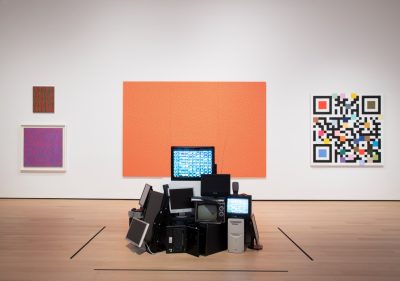
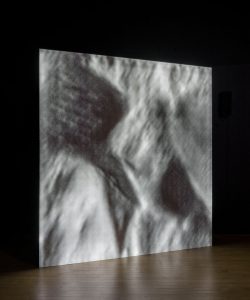
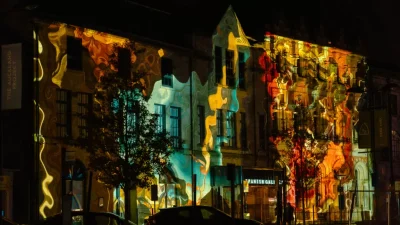
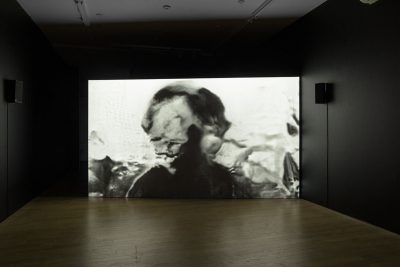
Daniel Canogar is a multidisciplinary artist who works in photography, video, sculpture, and installation. His most recent sculptural installations are constructed with discarded electronic materials: computers, telephones, and electric cables, thousands of burnt-out bulbs, meters of videotape, old slot machines, celluloid, DVDs. Salvaging these materials, Canogar reclaims the discarded technologies from junkyards and recycling centers—veritable cemeteries for consumer electronics—to examine the short life expectancy of consumer electronics that are so readily cast away. This cyclical consumption is indicative of a given society and age, yet hauntingly parallels organic mortality. In much of his work, Canogar seeks to bring dead materials back to life to reanimate the lifeless, reveal previously hidden secrets, and revive collective memory.
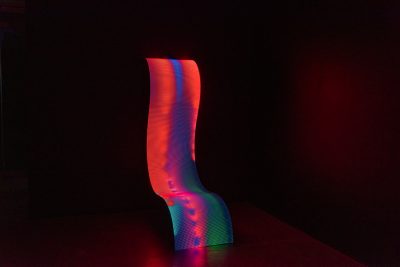
Nat Decker is a Chicago born Los Angeles based artist interpreting the intimacies of queer and disabled lived experience as provocation toward collective care and liberation. Creating between digital and material mediums, they identify the computer as an assistive tool affording a more accessible practice. They use digital 3D software to trace serpentine connections between the body and technology, reimagining fantastical mobility devices as cultural celebration and agitation of conventional desirability politics. This cyclically informs their work with sculpture, creating non-functional mobility devices as aesthetic scrutiny and frictional commentary on designations of usefulness. Nat is also an access worker, having consulted on accessibility for organizations such as p5.js, New Art City, Creative Growth, the LA Spoonie Collective, and for various projects at the University of California, Los Angeles.
Aurora Mititelu is an artist based inNew York, working with computer images, AI, and physical installations to examine how computational media constructs perception, identity, and autonomy. Informed by her experience growing up in post-socialist Romania amid the influx of Western digital culture, Mititelu’s practice reflects a critical interest in how media technologies shape social imaginaries.
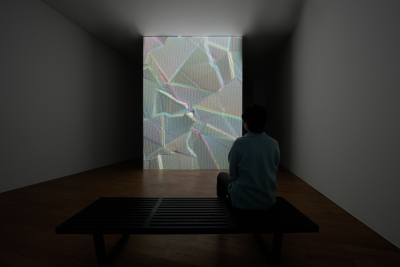
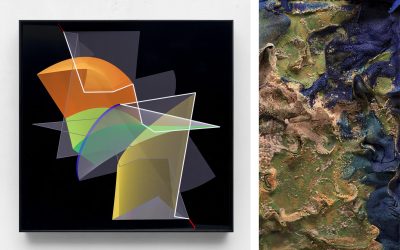
Casey Reas is an artist and educator who lives in Los Angeles. His software, prints, and installations have been featured in numerous solo and group exhibitions at museums and galleries. His work ranges from works on paper to urban-scale installations, and he balances solo work in the studio with collaborations. Reas’ work is in a range of private and public collections, including the Centre Georges Pompidou and the Whitney Museum of American Art. Reas is a professor at the University of California, Los Angeles. He holds a masters degree from the Massachusetts Institute of Technology in Media Arts and Sciences and a bachelor’s degree from the College of Design, Architecture, Art, and Planning at the University of Cincinnati. With Ben Fry, Reas initiated Processing in 2001; Processing is an open-source programming language and environment for the visual arts.
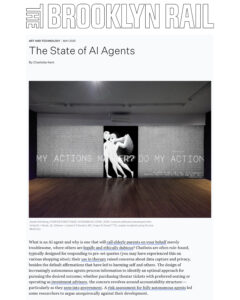
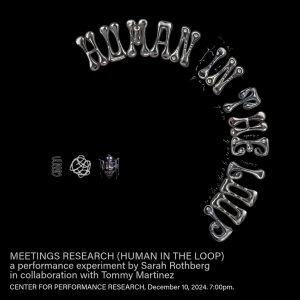
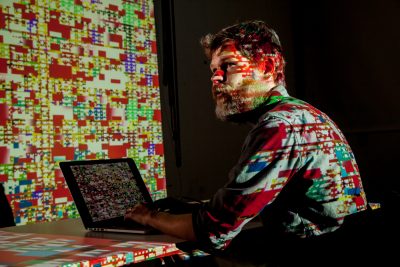
Sarah Rothberg creates playful, poetic, usually-a-bit-weird experiences that invite you to reconsider your relationship to the world around you. These take many forms ranging from interactive installation, to performance, video, writing, workshops, and experiments with technology. The artist’s experiences exist in a variety of contexts: at galleries, museums, festivals, on google docs, at the consumer electronics expo, screens in the NYC Subway system, zoom calls, secret twitter accounts, or MoMA.
Vera Petukhova is a Los Angeles–based curator originally from Minsk, Belarus and founder of Rip Space, a curatorial platform focused on emergent art forms and future-oriented art practice. Her work centers performance, moving image, experimental practice, and sensory research. She received her MA in Curatorial Practice from the School of Visual Arts. She has curated exhibitions at The Bronx Museum, CalArts, and Detroit Art Week, with past roles at Performa, The Kitchen NYC, Visions2030, and Tribeca Festival and her writing has been published in CARLA, OnCurating Magazine, and Performa Magazine.
Rip Space is a Los Angeles–based curatorial platform focused on future-oriented artistic practices across digital media, visual art, design, research, and sensory experimentation. Through exhibitions, collaborative programs, and public discourse, Rip Space supports artists in exploring emergent cultural and technological paradigms with an emphasis on process, experimentation, and collective inquiry.