
bitforms gallery is pleased to present Encoding Light, our first solo exhibition with Jim Campbell. Campbell is uniquely recognized for his use of low-resolution moving imagery and sculptural LED installations that explore where visual abstraction gives way to recognition.
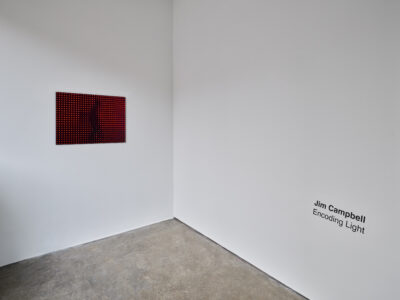
Jim Campbell
Encoding Light
January 24–March 7
Opening reception: Saturday, January 24, 5–7 PM
Gallery hours: Tuesday–Saturday: 11 AM–6 PM
bitforms gallery is pleased to present Encoding Light, our first solo exhibition with Jim Campbell. Campbell is uniquely recognized for his use of low-resolution moving imagery and sculptural LED installations that explore where visual abstraction gives way to recognition. The artist’s exhibition history spans more than three decades, tracing the evolution of his practice from early electronic and interactive works to large-scale LED installations. Early surveys such as Transforming Time (ASU Art Museum, 2000) and Quantizing Effects (SITE Santa Fe, 2005) established his investigation of time, memory, and low-resolution imagery. Major presentations, including Scattered Light at Madison Square Park (2010–11), Exploded Views at SFMOMA (2011–12), and Day for Night on San Francisco’s Salesforce Tower (2018) brought his work to broad public and institutional audiences. In recent years, continued solo and group exhibitions have reaffirmed Campbell’s central role in contemporary light and media art, consistently exploring the threshold between abstraction and recognition. A major component of Campbell’s practice traces how perception is constructed through visual information. Through the artist’s deliberate adjustments to resolution, slowing motion, and dispersing images across space, he foregrounds the human impulse to “fill in the gaps,” drawing on memory, experience, and expectation to make sense of what we see. Encoding Light situates Campbell’s historic works alongside a series of newly produced pieces.
Motion Color Study #6 is from a series of works that Campbell filmed in Claude Monet’s garden in Giverny, France. Through the artist’s positioning of this site, it becomes a historical hinge between two distinct yet conceptually aligned approaches to image making. Monet’s garden functioned as an environment translated to paint through color, light, and atmospheric variation. Campbell’s Motion Color Study returns to this same landscape through a contemporary, technological lens. Slow-moving footage of the garden is distributed across low-resolution LEDs behind a plexiglass screen, producing a blurred field in which color again becomes the primary vehicle of recognition. The comparison underscores a shared reliance on color as structure rather than ornament, and frames Campbell’s work not as a reinterpretation of Monet’s imagery, but as a continuation of his perceptual inquiry, translated from pigment to pixel.
Exploded View (Commuters) is a seminal work in Campbell’s Exploded View series, in which the artist transforms moving images into three-dimensional space using suspended arrays of LED lights. From most viewpoints, the arrangement of over 1,000 LEDs appears as an abstract constellation of flickering points, but from a specific vantage point the lights cohere into low-resolution figures of commuters traversing Grand Central Station. This oscillation between abstraction and recognition foregrounds Campbell’s ongoing investigation into how the mind assembles meaning from minimal visual information. By requiring viewers to move through the space to find and lose the image, the work encourages perception to be an active, embodied process that reveals how cognition completes what vision alone cannot fully resolve.
Memory / Recollection is a historic work from 1991 that captures still images of viewers and their surroundings in real time, intermittently storing and replaying them alongside live still imagery. Through a mix of still and live media, Campbell explores the fragile mechanics of remembrance and how images persist as impressions shaped by time, distance, and perception. In this tension between liveness and dissolution, past and present blur.
Together with several newly produced works, Encoding Light presents a sustained investigation into perception, memory, and the mechanics of recognition. Through live feeds, slowed motion, dispersed light, and low-resolution imagery, Campbell structures viewing as a deliberate process in which meaning is assembled rather than immediately given. The exhibition positions light not as a tool of representation, but as a material that shapes how visual information is processed. Taken as a whole, the works examine how understanding emerges through duration, movement, and the viewer’s active engagement with incomplete images.
*
Jim Campbell’s (b. 1956) work has been exhibited internationally and throughout North America in institutions such as the Whitney Museum of American Art, New York; the San Francisco Museum of Modern Art; The International Center for Photography, New York; The J. Paul Getty Museum, Los Angeles and the Museum of Contemporary Art, Sydney, Australia.
His electronic art work is included in the permanent collections of the Museum of Modern Art, New York; the Smithsonian American Art Museum, Washington, DC; the Whitney Museum of American Art; the Metropolitan Museum of Art, New York; the San Francisco Museum of Modern Art; the de Young Museum, San Francisco and the Berkeley Art Museum. In 2012, he was the recipient of the San Francisco Museum of Modern Art’s 13th Annual Bay Area Treasure Award.
Previous honors include a Rockefeller Foundation Fellowship Award in Multimedia, three Langlois Foundation Grants and a Guggenheim Fellowship Award. He has two Bachelor of Science Degrees in Mathematics and Engineering from MIT and as an engineer holds nearly twenty patents in the field of video image processing. His 2018 piece ‘Day for Night’ is a permanent LED installation that comprises the top nine floors of the 61-story Salesforce Tower in San Francisco.