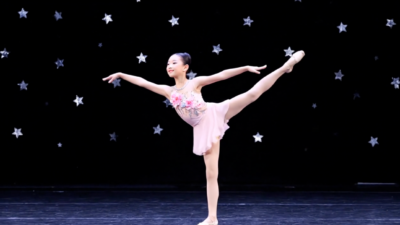
bitforms gallery is pleased to present StarPower, a solo exhibition featuring a generative, software-based body of work by Maya Man that explores the high-stakes world of youth competitive dance through the lens of AI-video models. Drawing from Man’s own childhood as a competitive dancer, AI-generated performers glide and spin across the screen in an ever-shifting sequence, periodically pausing to deliver confessional monologues reminiscent of reality television formats such as Dance Moms. Known for her examination of contemporary identity culture on the internet—particularly dominant narratives around femininity, authenticity, and the performance of self—Man stages an uneasy convergence of lived memory and synthetic simulation. In StarPower, sincerity and artifice collapse into one another, foregrounding how vulnerability, ambition, and selfhood are rehearsed and mediated within competitive spectacle and algorithmic systems.
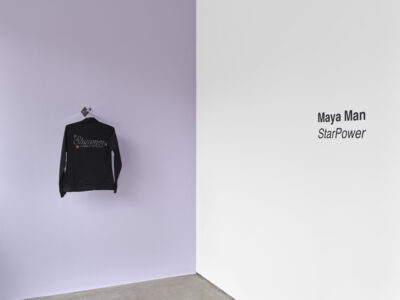
bitforms gallery is pleased to present StarPower, a solo exhibition featuring a generative, software-based body of work by Maya Man that explores the high-stakes world of youth competitive dance through the lens of AI-video models. Drawing from Man’s own childhood as a competitive dancer, AI-generated performers glide and spin across the screen in an ever-shifting sequence, periodically pausing to deliver confessional monologues reminiscent of reality television formats such as Dance Moms. Known for her examination of contemporary identity culture on the internet—particularly dominant narratives around femininity, authenticity, and the performance of self—Man stages an uneasy convergence of lived memory and synthetic simulation. In StarPower, sincerity and artifice collapse into one another, foregrounding how vulnerability, ambition, and selfhood are rehearsed and mediated within competitive spectacle and algorithmic systems.
StarQuest is the central work of the exhibition—a generative software project composed of 111 AI-generated scenes that looks to the world of American competitive dance to reflect the demands of contemporary online presentation. Produced solely using text-to-video and text-to-music models, the work draws from the artist's upbringing in the competition dance world: a hyper-feminine, performative environment where young dancers are trained to present themselves with ambition, polish, and discipline. The work specifically restages scenes and dialogue from Dance Moms, a Lifetime reality series set inside the high-intensity competition dance world, incorporating elaborate costumes, dramatic makeup, confessional interviews, and backstage rituals. Each eight-second clip functions as a scene in a fictional season of StarQuest—a title referencing a real competition the artist attended in her youth. Though the visual language is recognizable, the choreography veers into the uncanny: legs bend in impossible directions, two dancers merge into one. The competitive precision of dance becomes destabilized by the logic of artificial intelligence.
Custom software sequences the clips into a non-linear, generative stream that mirrors how content is consumed on TikTok and Instagram Reels. The season never unfolds the same way twice. StarQuest debuted in November 2025 with Feral File, curated by Nora O’Murchú. In Feral File’s online presentation, 111 one-of-one scenes were introduced with Man’s custom-built software for generating episodes by combining selected scenes. The bitforms gallery presentation further contextualizes the Feral File premiere of StarQuest, situating the software work alongside digital behind-the-scenes material and a physical box set.
Curator Nora O’Murchú clearly identifies the work’s protagonist:
"At the center of StarQuest is the 'AI default girl,' a synthetic performer born from datasets and optimized for beauty, obedience, and perfection. Caught in perpetual cycles of training, performing, winning, and losing, she embodies the paradox of contemporary visibility: to exist is to perform, and to perform is to repeat. Both product and performer, she mirrors the conditions of digital life, where the boundaries between labor, entertainment, and identity blur."
By merging autobiographical memory with AI hallucination, Man interrogates the mechanics of performance, the aesthetics of optimization, and the ways that selfhood is shaped by systems of competition and quantification. The work reflects the instability of “reality” today, leaving viewers caught inside its infinite loop as the dancer—and the model—work endlessly to win.
StarQuest Edits emerge from moments within the central generative work and take the form of “fan edits,” an internet-native phenomenon on platforms such as TikTok and YouTube where users reassemble existing footage into condensed montages that amplify particular characters, personalities, or emotional arcs. Drawing from the AI-generated dancers and confessional monologues of StarQuest, these edits use existing CapCut templates to isolate fleeting moments of performance and transform them into stylized loops that echo the rhythms and aesthetics of social media fan culture. Each edit is exhibited on an iPhone, mounted with a familiar selfie accessory, and affixed to mirrored tiles often seen in home dance studios or gyms. Together, these elements point towards the circulation of young women’s bodies online as content and algorithmically mediated spectacle.
Within the exhibition, Man undertakes a sustained act of worldbuilding. Her layered narratives, character arcs, and studio ephemera operate as both fiction and infrastructure. In several behind-the-scenes segments of StarQuest, dancers are interviewed in the studio, and in the background, viewers may notice a sign that reads “Shimmer.” The word did not begin as a deliberate branding choice but emerged unexpectedly from the artist’s AI experiments, ultimately becoming the fictional dance company at the center of StarQuest. The Shimmer Quotes series draws from the motivational posters commonly found in classrooms, gyms, and dance studios—spaces where slogans promise confidence and resilience amid demanding training cultures. Drawing on language from motivational posters seen in the Abby Lee Dance Company studio as well as phrases from the Instagram posts of Man’s childhood dance studio, the generated quotes attempt to offer encouragement but often collapse into contradiction or absurdity. The resulting slogans, such as “With a Little Sparkle, Anything Is Hard”, sharpen Man’s exploration of performance and algorithmic influence.
Coach’s Shimmer Warm-Up Jacket also appears in various scenes in StarQuest, embedding Shimmer further into the fabricated world of the dancers. Affixed to the jacket are competition pins from the real-life StarPower dance competition, a competition Man herself participated in that has been in existence for over thirty-five years. The pins operate as a bridge between staged storytelling and real-world performance. The company’s slogan, “You’re always a star at StarPower!”, seamlessly complements Man’s constructed reality. Coach’s Shimmer Warm-Up Jacket is also worn as a costume in Man’s StarQuest lecture-performance, a conversation on spectacle, performance, and the online stage in the age of generative AI. The performance integrates Man’s generative work with online content and choreography to consider the parallels between competition dance culture in America and today’s algorithmic ecosystem that encourages a quantifiable performance of self.
StarPower traces the cultural choreography that shapes how young women learn to perform for an audience. Man’s translation of competitive dance aesthetics into the language of machine learning exposes the shared logics of repetition, refinement, and optimization in both dancers and AI systems. The exhibition positions performance not merely as entertainment, but as a pervasive condition of contemporary life, where identity is continually rehearsed and edited.